Lake Skarve
The CallerLake Skarve is a calm, difficult-to-reach stretch of water beside Bjerkås, but its apparent stillness does not make it marginal to the investigation. The lake’s waterfront places Konrad Sejer near a local shop, where an animal postcard gives him a way to imagine the attacker not as a distant menace but as someone who might share the community’s everyday routes.
Setting and surroundings
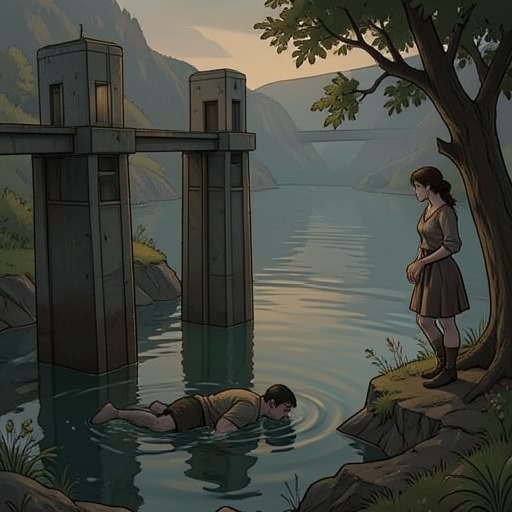
The lake lies beside Bjerkås, a town of roughly five thousand residents. When Konrad Sejer drives there in the early morning, he follows directions to the Spar supermarket near the water: after turning right at Bjerkås Centre, he sees the shop’s conspicuous flags by the waterfront. A narrow asphalt path leads down to the shore. Its promise of a pleasant beach is undercut by the actual terrain, where large, sharp stones form a barrier instead of sand. Swimming seems unlikely, a practical explanation for why a Spar business could operate so close to the water.
The shoreline is used rather than picturesque in any uncomplicated sense. Boats have been hauled up along it, some overturned, and the lake lies so still that it resembles a mirror. Ducks move across the surface, leaving rings in their wake. Frank tests the cold water, returns to shore, and later stands growling at the ducks until Sejer tells him to leave them alone. The scene gives the waterfront a small, observable life of its own: a place where boats, birds, a dog, and a passing investigator briefly occupy the same quiet edge.
The town’s other landmarks widen the view beyond the shore. Sejer passes an old red-brick dairy building on the way down to the water; across the lake, a large white former cloister stands partway up a ridge. Its small chapel hosts concerts and readings. These details place the lake within a settled community with remnants of older local institutions, not in an isolated wilderness. At the same time, the nearby shopkeeper’s account suggests a shrinking town centre: Bjerkås once had a bakery, hairdresser, café, and bank, but these businesses closed one after another. The remaining local services include the grocery and petrol station, with a small bar beside the station.
A local route into the investigation
The Spar is more than a point of orientation. Residents of the Askeland housing estate use it after their own Joker shop closed, although more people increasingly travel to Kirkeby for a wider selection. Sejer learns these details while asking about the area’s shops, then drives the twenty-five kilometres to Bjerkås and finds the waterfront exactly where he was told. The route connects the investigation to the habits of local residents: shopping patterns, closed businesses, and the places people still have reason to visit.
Inside the Spar, Sejer follows the smell of freshly cooked food to the delicatessen and buys two meatballs. At the checkout, carrying the warm aluminium bag, he finds a rack of postcards. Among cards showing kittens, puppies, and horses, one stands out: a lynx card identified on the back as part of a series on Norwegian mammals and credited to photographer Gøran Jansson. The specific animal matters because the investigation has already turned toward the possibility of a predator behind the attacks. The card does not identify a culprit, but it changes how Sejer reads the place around him.
The postcard and the lake’s narrative role
The card makes the ordinary shop feel newly charged. Sejer reasons that the person responsible has been there and may live in Bjerkås or Askeland, perhaps even shop at this Spar. That conclusion is a suspicion about proximity, not proof; the postcard’s importance lies in how it supplies a concrete local possibility. A mass-market rack of animal pictures becomes an investigative clue because it is encountered where residents buy groceries and where people from nearby settlements now converge.
After a newspaper headline about a baby sleeping in blood, Sejer eats small bites of his meatball while looking across the mirror-still lake. The ducks continue rocking gently, undisturbed. Against this calm, he tells Jacob Skarre that more attacks will follow and that they are dealing with a beast of prey. The moment links the exposed violence of the headline to the tranquil landscape without turning the lake itself into a source of danger. Its stillness instead sharpens the contrast: the threatening pattern is recognized in the midst of an ordinary morning, beside familiar water and a neighbourhood shop.
Community, stillness, and proximity
Lake Skarve matters through its connections: the waterfront Spar, the surrounding settlements, and the local routes that make a possible offender’s presence imaginable. Sejer’s visit moves from directions and landmarks to observation, then from a postcard to a working theory. The lake does not solve the case, and the evidence does not establish that the attacker lives beside it. It gives the investigation a geography of everyday contact, where a clue can be found among greeting cards and a person of interest could be an ordinary customer.
The ducks and the undisturbed surface also provide a counter-image to the attacks. Sejer watches the lake after confronting the headline, while Frank’s brief, instinctive reactions to the water and birds remain small incidents within the morning. The scene’s tension comes from the gap between what the setting appears to promise—quiet, routine, a place where people shop and walk—and the violence Sejer expects to continue. Lake Skarve is thus both a real local setting and the calm foreground against which the investigation’s growing threat becomes visible.